Institución
Museo de Historia Natural de Valparaíso
Autores
Cinthia Mora Troncoso
Resumen en inglés (Abstract)
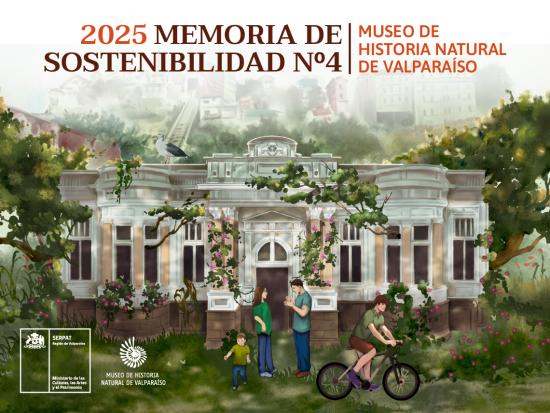
The Museum Sustainability Reports are a clear example of the institution’s growth and commitment to environmental matters. Through its team, the contribution of its partners, and the ever-necessary coordination with other relevant regional actors, the Museum has decided to make steady progress on facilitating access to knowledge and tools for the inhabitants of the Valparaíso region and its visitors, in order to raise awareness, reflect, and address the global crisis. We expect to jointly promote different actions aimed at empowering citizens to protect and conserve diverse ecosystems, vital for human life on the planet.
In this fourth edition of the Memoria del Museo de Historia Natural de Valparaíso (sustainability report), significant advances in areas such as environment, circular economy, culture, and social perspective are reported. These advances enabled us to achieve the “Excellence” level of Oficina Verde, an accreditation program led by the Ministry of the Environment, which recognized our Museum as the first one in Chile to contribute to the reduction of organizational carbon footprint and—in turn—to the mitigation of the negative impacts arising from its administrative and technical processes.
For this public institution, bringing this type of information closer to the community is an essential role. Education and research on natural heritage are core elements of the Museum’s Vision and Mission, along with efforts to mitigate the impacts upon it, most of which stem from human activity, such as biodiversity loss, increased pollution, and climate change. In addition, we are committed to being a coherent space that engages with problems and solutions in a spirit of service to the community. Consistent with that approach, we aim to face together the great challenges associated with building societies with a socio-environmental justice perspective, to advance toward sustainable development.
In this regard, we firmly believe that our sustainability reports are a relevant channel to share our commitments and convictions, with the purpose of encouraging other institutions to adopt more environmentally friendly practices aimed at establishing a lasting, collectively built environmental and sustainable culture.
In this fourth edition of the Memoria del Museo de Historia Natural de Valparaíso (sustainability report), significant advances in areas such as environment, circular economy, culture, and social perspective are reported. These advances enabled us to achieve the “Excellence” level of Oficina Verde, an accreditation program led by the Ministry of the Environment, which recognized our Museum as the first one in Chile to contribute to the reduction of organizational carbon footprint and—in turn—to the mitigation of the negative impacts arising from its administrative and technical processes.
For this public institution, bringing this type of information closer to the community is an essential role. Education and research on natural heritage are core elements of the Museum’s Vision and Mission, along with efforts to mitigate the impacts upon it, most of which stem from human activity, such as biodiversity loss, increased pollution, and climate change. In addition, we are committed to being a coherent space that engages with problems and solutions in a spirit of service to the community. Consistent with that approach, we aim to face together the great challenges associated with building societies with a socio-environmental justice perspective, to advance toward sustainable development.
In this regard, we firmly believe that our sustainability reports are a relevant channel to share our commitments and convictions, with the purpose of encouraging other institutions to adopt more environmentally friendly practices aimed at establishing a lasting, collectively built environmental and sustainable culture.
Resumen en español
English version
Tania Roza Villanueva, Director of the English Translation
and Interpreting Program at Universidad de las Américas.
Karina Castro, Coordinator, Center for Translation and Interpretation,
Universidad de las Americas UDLA.
Esteban González and Vanessa Aguilar, graduates
Tania Roza Villanueva, Director of the English Translation
and Interpreting Program at Universidad de las Américas.
Karina Castro, Coordinator, Center for Translation and Interpretation,
Universidad de las Americas UDLA.
Esteban González and Vanessa Aguilar, graduates
Fecha de publicación
22/10/2026
Idioma
Inglés
Página
48
Colección
Gestión Ambiental
Index
SUSTAINABILITY REPORT Nº 4 MUSEO DE HISTORIA NATURAL DE VALPARAÍSO 2025
Spanish version (Esp)
4 Prologue 5 Introduction 7 About Us 11 Sustainability Pillars and Sustainable Development Goals 19 Environmental Management Plan 2025 25 Environmental Management Plan Results 33 Community Engagement 43 Conclusions Sources Consulted